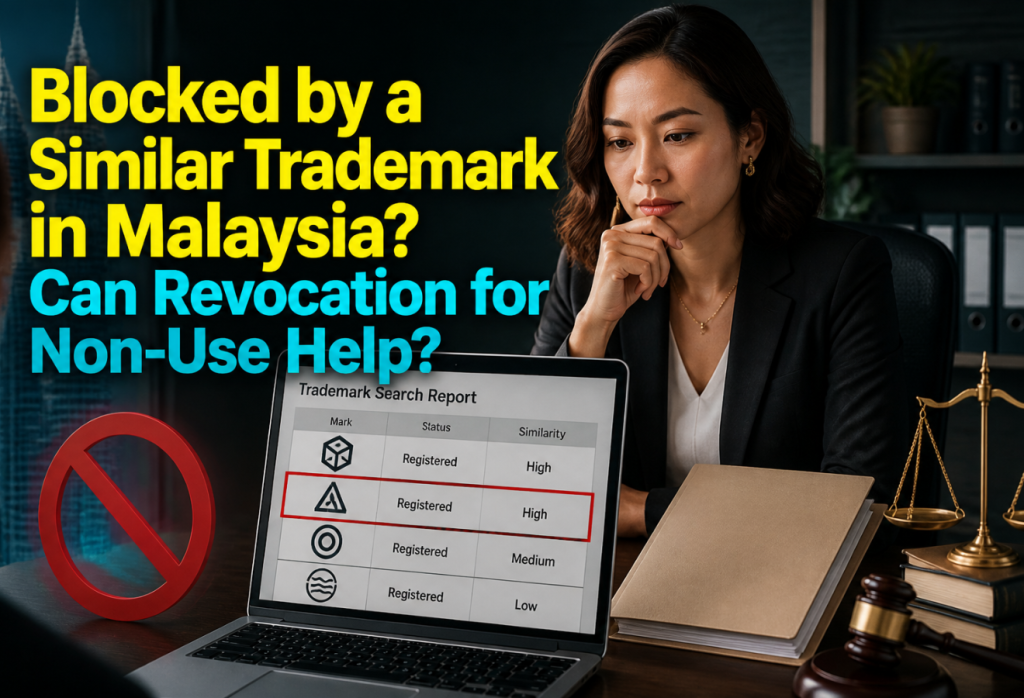
You have chosen a name for your business and are ready to apply for a Malaysian trademark. However, your search reveals an earlier registered trademark that is similar to your proposed mark and covers similar goods or services.
When you investigate further, the trademark appears to be inactive. The owner’s website and online social media pages reveal no recent operation. Does that mean the existing registration can no longer affect your new trademark application?
A registered trademark does not automatically lose protection merely because it appears to have disappeared from the market. However, if the mark has not been genuinely used in Malaysia for three-year period, an aggrieved person may apply to the court under section 46 of the Trade Marks Act 2019 for revocation on grounds of non-use. If successful, the registration may be removed or limited for the goods or services that the owner has not genuinely used the mark for.
What Must You Show Before Applying for Revocation?
Before considering revocation, a business must first show that it is genuinely affected by the earlier trademark and identify the specific registration, class or goods and services creating the problem.
Under section 46 of the Trademark Act 2019, the applicant must be an “aggrieved person”. In practical terms, this means there must be a real connection between the earlier registration and the applicant’s business, proposed trademark or application. It is not enough to find an old registration inconvenient or to believe that the owner no longer deserves to keep it.
The decision in Oatly AB v Pahang Pharmacy Sdn Bhd (2022) illustrates the practical “use it or lose it” principle in trademark law. Pahang Pharmacy owned registrations for the similar OATLEY mark in Classes 5, 16 and 29. Oatly argued that the marks had not been genuinely used in Malaysia and that the registrations were obstructing its own OATLY applications.
The High Court accepted that Oatly was genuinely affected by the registrations in Classes 5 and 29 because they were directly hindering its applications in those classes. However, Oatly did not establish the same connection with the Class 16 registration. Its revocation challenge therefore succeeded only in relation to the registrations that were actually creating a problem for its business.
The lesson is that a trademark owner cannot necessarily keep a registration indefinitely without using it. However, a business seeking a non-use revocation application should be directed at the specific registration, class and goods or services that are creating the problem.
Which Three-Year Period Applies to the Revocation Challenge?
A common misunderstanding is that using a trademark during the first three years after registration protects it indefinitely. The Oatly decision shows why that is not necessarily correct.
Section 46(1) of the Trademark Act 2019 addresses two different situations. The first concerns a trademark that was not put to genuine use in Malaysia during the initial three-year period following the notification of registration. The second concerns a later period in which use of the trademark was suspended for three uninterrupted years.
This means that a trademark owner may face a non-use challenge even if the mark was used when it was first registered. Old invoices may prove that the brand once existed, but they may not answer a later claim that the mark was subsequently left unused.
For this reason, businesses should identify the correct date of registration and the precise three-year period relevant to the proposed revocation. The question is not simply whether the mark was ever used. The question is whether it was used in good faith in Malaysia for the relevant goods or services during the relevant period.
Revocation May Be Partial
Even where a non-use challenge succeeds, the earlier registration may not disappear completely.
This can be seen in the recent Court of Appeal decision in TransferWise Ltd v Public Bank Berhad. TransferWise challenged Public Bank’s WISE-formative trademark registration in Class 36. The registration covered a wide range of banking, financial and related services, but the evidence showed that the mark had been used mainly for children’s savings accounts.
The Court of Appeal found that the registration should be partially revoked. However, it retained the broader categories of “banking” and “financial” services because the children’s savings account services fell within those categories. The registration was therefore narrowed, but it was not limited only to the words “children’s savings accounts”.
This matters because an applicant may prove non-use for several specific services and still find that broader categories remain on the Register.
A court may remove goods or services that are not supported by genuine use, but it does not necessarily rewrite the registration to match the narrowest description of the owner’s actual business. The remaining specification may still be relevant to a later trademark application.
KEY TAKEAWAY FOR BUSINESSES
If you own a registered trademark, the registration should be supported by genuine use in Malaysia. The mark should be used for the goods or services covered by the registration. Businesses should also keep supporting records such as invoices, product packaging, advertisements, website pages, marketplace listings and social media materials. These records may be important if the registration is later challenged for non-use.
If a similar earlier trademark appears in your search, this does not necessarily mean that your application has no chance of success. The earlier registration may not have been used, may only cover goods or services that are different from yours, or may be capable of being narrowed or addressed through consent, co-existence or other filing strategies.
The appropriate approach will depend on the registrations involved, the actual use of the marks and the goods or services concerned. Businesses should therefore obtain a proper trademark clearance assessment before committing significant time and money to a new brand.
If a similar trademark is affecting your application, contact Flexly IP for an assessment of the available options and a filing strategy appropriate to your business.